
The AI Amplification Effect
Artificial intelligence collapses strategic insight from weeks to minutes while delayering removes interpretive layers. The result: amplified trajectories where correct moves compound faster but errors propagate deeper. New operating-model framework for mid-market leaders.

Why Faster Insight and Flatter Organizations Are Changing the Operating Physics of the Firm
For decades management thinkers warned that attention, not information, was the scarce resource inside complex organizations. Artificial intelligence is now shifting the constraint once again. In an era of abundant insight and flattened organizations, the scarcest resource is no longer analysis. It is organizational judgment.
Introduction
When commercial aircraft adopted fly-by-wire technology, they became dramatically more responsive to pilot inputs. But engineers quickly discovered that greater responsiveness came with a new danger. Without sophisticated stabilization systems, aircraft could enter pilot-induced oscillations - small control inputs that produced widening swings until the aircraft became unstable.
The solution was not slower aircraft or thicker manuals. It was smarter damping. Digital flight-control systems moderated pilot inputs, preserving maneuverability while preventing destabilizing overcorrections.
Organizations today are entering a similar moment.
Artificial intelligence has collapsed the time required to generate strategic insight. Tasks that once required weeks of analysis, modeling, and cross-functional review now produce high-confidence recommendations in minutes through agentic systems and enterprise-scale data models.
At the same time, the organizational layers that historically interpreted and moderated those signals are rapidly thinning. For decades corporations experimented with flatter structures, removing management tiers in pursuit of speed and efficiency. AI is now accelerating that trend. As leaders see analysis becoming automated and decision cycles compressing, many are concluding that fewer human intermediaries are required between strategy and execution.
The result is a subtle but powerful shift in how organizations move.
Strategic signals arrive faster just as the interpretive layers that once translated and challenged those signals are disappearing. Strategic decisions therefore propagate farther and faster through organizations before course correction can intervene.
We call this the AI Amplification Effect.
The AI Amplification Effect occurs when accelerated analytical signal generation combines with thinning interpretive layers inside organizations, causing strategic decisions to propagate further and faster before corrective feedback intervenes.
Correct initiatives compound at unprecedented speed. Flawed ones travel deeper into execution before their consequences surface.
“In an era of abundant insight and flattened organizations, the scarcest resource is no longer analysis. It is organizational judgment.”
In this environment, competitive advantage will not accrue to the organizations generating the most ideas. It will belong to those capable of maintaining navigational control as the pace of strategic movement accelerates - because the binding constraint has shifted from deciding what to do to governing how far and how fast action travels before correction can intervene.
1. The Amplification Moment
By early 2026, the timeline from strategic insight to actionable option has collapsed. Generative and agentic AI systems now ingest enterprise data, run simulations, and deliver ranked recommendations in minutes - tasks that once required weeks of analysis and cross-functional review. What was once a natural pause in the strategy process has largely disappeared.
Adoption has been rapid. McKinsey’s State of AI 2025 reports that nearly 90% of organizations now use AI in at least one function, with generative and agentic systems spreading quickly across planning and operational workflows. Yet measurable enterprise-level impact remains modest for most firms, suggesting that the technology is moving through organizations faster than their operating models can adapt.
Analytical latency - the quiet delay that once forced reflection, translation, and challenge - has largely evaporated.
High-confidence signals now reach executive teams directly, just as the interpretive layers that once moderated those signals are thinning.
2. The Erosion of Interpretive Layers
Organizations historically inserted deliberate interpretive friction into strategy and execution. Annual budgets, capital committees, transformation offices, and - most importantly - middle-management layers (VPs, senior directors, seasoned operators) translated abstract signals into operational reality, challenged premature scaling, recognized second-order risks, remembered past failures, and paced change to preserve coherence.
These layers were often criticized as bureaucratic drag. Yet they performed an essential stabilizing function: contextual judgment, pattern recognition across contexts, and early course correction. Delayering - driven by AI-enabled productivity gains, relentless margin pressure, and cultural demands for speed and autonomy - has removed the container for that function. Recent moves at firms such as Block, Oracle, and Amazon illustrate the trend: workforce flattening and smaller execution teams coincide exactly with AI’s acceleration of insight.
The trajectory toward flatter organizations is not reversing. The function of interpretive stabilization, however, remains essential - and AI now makes its absence acutely visible.
3. AI as Accelerator of Decision Velocity
Artificial intelligence now surfaces polished, probabilistic recommendations directly to executives. Pricing adjustments, supply chain redesigns, automation opportunities, and new market segments can be modeled and ranked in minutes. What previously required weeks of analysis and cross functional debate now arrives as a high confidence recommendation ready for action.
The analysis appears rigorous and low risk, which lowers the perceived cost of commitment. Leaders see compelling recommendations without the interpretive pause that once accompanied major strategic moves. The instinct becomes simple: if the model indicates the opportunity is sound, move quickly.
Yet analytical systems lack several forms of judgment that experienced operators accumulate over time. They do not carry memory of past failures inside the organization. They cannot recognize patterns across industries or economic cycles. And they cannot fully anticipate the operational strain large initiatives place on real teams and real systems.
When the managerial layers that once supplied this judgment begin to thin, strategic signals move through the organization with far less translation or challenge than before. The result is not reckless leadership. It is a structural shift in how decisions travel. Strategic recommendations convert into organizational commitments earlier in the execution cycle because the stabilizing influence that once moderated escalation has weakened.
Organizations are therefore moving faster at the exact moment their capacity to interpret and moderate strategic signals is eroding.
“Organizations are moving faster at the exact moment their navigational capacity is eroding.”
4. The Mechanics of Amplification
Fast signals enable rapid executive commitment, which amplifies strategic trajectories. Correct initiatives compound faster than ever. Flawed ones propagate much farther before correction arrives. The result is wider outcome variance across strategic programs.
In many cases the early signals driving commitment are incomplete or misleading. Analytical systems identify statistically attractive opportunities, but they cannot fully anticipate the organizational friction that emerges during execution. As a result, initiatives that appear promising in early analysis can scale quickly before operational realities surface.
Behavioral economics shows that losses loom larger than equivalent gains. When an amplified initiative fails visibly, organizations often respond sharply - halting programs, shifting priorities, or abandoning the effort rather than sustaining disciplined iteration.
The cycle increasingly follows a recognizable pattern:

As the next exhibit illustrates, accelerated signal generation combined with thinner interpretive layers produces amplified strategic trajectories. Momentum builds quickly when early signals appear positive, but when losses emerge the organizational response is often abrupt retrenchment, causing strategic momentum to collapse.
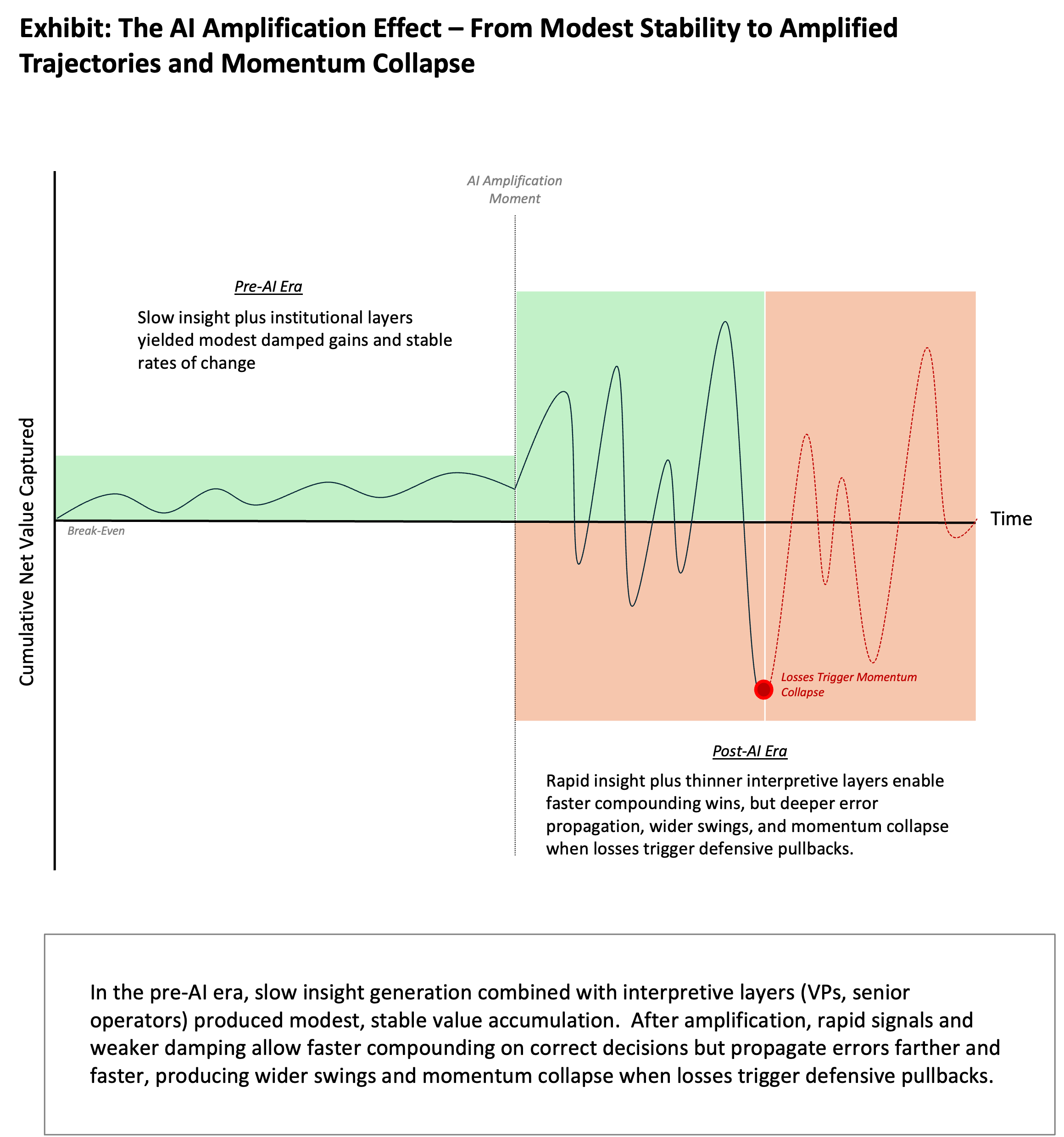
In aviation, fly-by-wire increased responsiveness but risked oscillations without digital damping. Organizations face the parallel: AI increases strategic responsiveness just as interpretive layers that once damped trajectories have disappeared. The required stabilizer is not more technology, it is experienced human judgment delivered in new, lightweight forms.
Real world experience is bearing this out. MIT analyses in 2025, including the GenAI Divide report, indicate that roughly 95% of generative AI pilots yield zero measurable P&L impact or scale, largely because correction arrives too late for learning to compound.
5. Why Mid-Market Organizations Feel It Acutely
Mid-market firms ($100M–$2B revenue) encounter the effect hardest and soonest. They generate abundant AI signals from meaningful complexity but lack enterprise-grade interpretive buffers or formal portfolio processes. Executive teams - often 5–8 members - become the immediate bottleneck.
RSM’s Middle Market AI Survey 2025 captures the squeeze: 91% use generative AI (up from 77% the prior year), yet only 25% report full integration into core operations, with persistent hurdles in data quality, skills, and rollout. Without inherited stabilizers, amplification manifests faster - rapid launches followed by abrupt de-prioritization.
6. Organizational Judgment as the New Scarce Resource
Finite execution capacity now collides with accelerated insight, elevating three irreplaceable human capabilities:
Strategic judgment under uncertainty - the discipline to reject analytically valid but non-core moves, prioritize coherent direction, and preserve narrative focus amid noise.
Clear execution ownership - unambiguous accountability and sequencing authority to enforce “stop” decisions and minimize destructive churn.
Continuity-preserving leadership - intentional pacing to safeguard institutional memory and operational stability through higher-variance cycles.
These were always valuable; the AI Amplification Effect renders them scarce and decisive. Humans may be less needed for coordination or monitoring, but directional judgment under acceleration becomes more - not less essential.
“Speed without navigational control is not advantage – it is instability.”
7. Emerging Ways to Restore Stabilization
As strategic decision velocity accelerates, organizations are rediscovering a capability older corporate structure once provided quietly: judgment-rich stabilization. Historically, managerial layers translated strategic signals into operational reality. They challenged premature commitments, surfaced second-order risks, and slowed escalation until assumptions were tested.
As those layers thin and AI-driven signals arrive faster, organizations must find new ways to restore that stabilizing function without rebuilding the bureaucratic hierarchies of the past.
Several adaptations are beginning to emerge.
Some firms are strengthening portfolio governance, introducing explicit prioritization cadences and kill disciplines to prevent AI-generated initiatives from fragmenting execution. Others are experimenting with lightweight navigation councils, small groups of experienced operators tasked with challenging assumptions and surfacing hidden risks as initiatives begin to scale.
Another approach gaining traction involves seasoned operators in fractional or interim roles, providing pattern recognition, execution realism, and independent challenge without adding permanent hierarchy. Mentions of fractional executive roles have tripled since 2018 according to Revelio Labs, and Gartner projects that more than 30% of midsize firms will have at least one fractional executive on retainer by 2027.
These mechanisms differ structurally, but they perform the same function: they reintroduce interpretation and course correction into increasingly accelerated decision systems. The goal is not to slow organizations down, but to ensure that speed does not come at the expense of direction.
8. The New Leadership Equation
Artificial intelligence is accelerating strategic signal generation at the same moment many corporations have collapsed the managerial layers that historically translated strategy into operational judgment. While flatter organizations and faster analysis promise speed, they also remove the stabilizing mechanisms that historically moderated strategic overreach. The result is amplified strategic trajectories, where correct decisions compound quickly but incorrect ones propagate much further before correction.
Advantage will accrue to organizations that govern this amplification - preserving momentum through judgment-rich friction long enough for learning and value capture to compound.
A New Constraint in the AI Era
For decades, management scholarship has focused on the limits organizations face when making decisions.
Herbert Simon introduced the idea of bounded rationality, showing that managers cannot process all available information and must rely on simplified judgments.
Later work emphasized the role of organizational attention. As information environments expanded, the scarce resource became what leaders could focus on and prioritize.
More recent operating models focused on speed. Digital systems promised faster insight, flatter organizations, and shorter paths from signal to decision.
Artificial intelligence alters this equation.
By dramatically reducing the time required to generate high-confidence analysis, AI removes a constraint that historically slowed strategic commitment. At the same moment, many organizations are continuing to thin the managerial layers that once interpreted and moderated strategic signals.
The result is a new operating challenge.
Earlier generations of operating-model thinking taught us how to move faster under conditions of scarcity. The AI era demands something new: learning how to move with control under conditions of abundance.
In the AI era, navigational control under acceleration is the decisive leadership challenge.
About the Authors
Jon Watts and Dev D’Souza are co-founders of Propel Strategy Group, an operator-led advisory firm focused on large-scale operational and technological transformation for mid-market companies. Their work examines how leadership, operating models, and execution must evolve as artificial intelligence accelerates strategic decision-making.
References
Cyert, Richard M., and James G. March. A Behavioral Theory of the Firm. Englewood Cliffs, NJ: Prentice-Hall, Inc., 1963.
Davenport, Thomas H., and John C. Beck. The Attention Economy: Understanding the New Currency of Business. Boston: Harvard Business School Press, 2001.
Deloitte. State of AI in the Enterprise. Deloitte Insights, 2026.
Gartner. The Future of Fractional Leadership. Gartner Research, 2024.
March, James G., and Herbert A. Simon. Organizations. New York: Wiley, 1958.
McKinsey & Company. The State of AI in 2025: Generative AI’s Breakout Year. McKinsey & Company, 2025.
Simon, Herbert A. Administrative Behavior: A Study of Decision-Making Processes in Administrative Organizations. New York: Macmillan, 1947.
Thompson, James D. Organizations in Action: Social Science Bases of Administrative Theory. New York: McGraw-Hill, 1967.
Revelio Labs. Workforce Intelligence Report on the Rise of Fractional Executives. 2024.