

A Business System Of One
For the past forty years enterprise technologies have helped organizations scale and standardize processes. AI introduces a different possibility - scaling an organization’s unique capabilities and advantages directly into business systems, to create a Business System Of One.
Executive Summary
For much of the past forty years, enterprise technology has created value through standardization. ERP systems, CRM platforms, outsourcing providers, and consulting frameworks helped organizations reduce complexity, improve consistency, lower costs, and scale operations. The economic logic was compelling: standardization made organizations more efficient.
This model has been remarkably successful, but it also introduced a tradeoff. As organizations adopted common systems, processes, and operating models, many became increasingly similar in how they worked. Competitive differentiation often remained outside formal systems, residing instead in expertise, customer relationships, institutional knowledge, organizational culture, and accumulated experience. These assets created value, but they were difficult to capture, transfer, and scale.
Artificial intelligence introduces a fundamentally different possibility. Unlike traditional enterprise software, AI can increasingly adapt to an organization's unique context rather than requiring the organization to adapt to the software. Expertise can be embedded into workflows, institutional knowledge can become more accessible, customer interactions can reflect specialized understanding, and decision-support systems can incorporate organizational context that previously existed only within experienced teams.
This shift has implications that extend beyond productivity and automation. While many organizations initially focus on efficiency gains, AI creates value through three broader forms of augmentation. Process Augmentation improves the speed, quality, consistency, and scalability of work. Decision Augmentation improves forecasting, planning, risk assessment, and judgment. Commercial Augmentation strengthens customer acquisition, retention, expansion, and monetization. Together, these capabilities create the foundation for what we describe as a Business System of One: an operating model that reflects an organization's unique competitive strengths.
This does not imply the end of standardization. Organizations will continue to rely on common infrastructure, controls, and enterprise platforms. The difference lies in where they choose to differentiate. Historically, technology excelled at standardizing transactions and processes. AI creates the possibility of scaling expertise, judgment, and relationships that were previously difficult to embed within systems.
The long-term significance of AI may therefore be broader than efficiency alone. Organizations that focus exclusively on automation will likely realize meaningful operational improvements. Organizations that use AI to strengthen decision-making, deepen customer relationships, and scale the capabilities that make them distinctive may create more durable forms of competitive advantage. In this sense, AI may represent more than another technology wave. It may alter the longstanding tradeoff between scale and uniqueness that has shaped enterprise technology for decades.
1. The Standardization Era
To understand why artificial intelligence may represent a meaningful shift in enterprise technology, it is helpful to understand the economic logic that shaped the technologies that came before it.
For much of the past forty years, enterprise technology has been built around a common objective: standardization. Enterprise Resource Planning systems standardized financial processes, inventory management, procurement, manufacturing, and reporting. Customer Relationship Management platforms standardized how organizations tracked prospects, managed customer interactions, and measured sales performance. Shared service organizations, outsourcing providers, and consulting frameworks similarly promoted common operating models designed to improve consistency and efficiency. This trend was driven by economics.
Historically, software was expensive to develop, implement, customize, and maintain. Every unique workflow increased complexity. Every exception introduced additional support requirements. Every customization created cost, risk, and technical debt. Organizations were therefore encouraged to adapt their processes to the software rather than adapting the software to their processes.
The benefits were substantial. Standardization reduced operating costs, improved controls, increased visibility into performance, and enabled organizations to scale more effectively. Common processes simplified training, shared data structures improved reporting, and standardized workflows reduced variability across business units, geographies, and functional areas. For many organizations, these benefits far outweighed the costs. Enterprise technology became a powerful engine of productivity and operational performance. And yet, standardization introduced a less visible tradeoff.
As organizations adopted the same enterprise platforms, process frameworks, and management practices, many aspects of how they operated became increasingly similar. Competitive differentiation often remained outside the technology stack, residing instead in experienced employees, expertise, institutional knowledge, customer relationships, and organizational culture. These characteristics continued to create value, but they were often difficult to capture, transfer, or scale through traditional enterprise systems.
This distinction shaped where organizations created value. Enterprise technology became exceptionally effective at managing transactions, enforcing process discipline, and creating operational consistency. It was far less effective at capturing judgment, experience, context, and the informal knowledge that often distinguishes high-performing organizations from their competitors.
As a result, many organizations operated with two parallel systems. The formal system consisted of software, workflows, policies, and procedures. The informal system consisted of relationships, expertise, institutional memory, and practical experience. Both were essential, but only one scaled easily through technology.
For decades, this tradeoff was largely accepted because there were few viable alternatives. The economics of enterprise technology favored standardization, and standardization delivered significant value. The question now is whether artificial intelligence changes these economics sufficiently to make a different approach possible.
2. Why AI Is Different
The emergence of artificial intelligence does not eliminate the benefits of standardization. Organizations will continue to rely on common infrastructure, shared data platforms, standardized controls, and consistent operating practices. The question is not whether standardization disappears, but whether AI changes where organizations choose to standardize and where they choose to differentiate.
Traditional enterprise systems were designed to process transactions, enforce workflows, and manage structured information. Artificial intelligence operates differently. Modern AI systems can work with unstructured information, interpret natural language, identify patterns, summarize knowledge, and support increasingly sophisticated interactions between people and systems. More importantly, they can be adapted to reflect the unique context of the organizations that use them.
This distinction is subtle but important. Traditional software created value primarily by helping organizations operate in similar ways. AI creates value by helping organizations preserve and scale the ways in which they are different.
Many organizations possess expertise that has accumulated over years or decades of operating experience. Some of that knowledge exists in documentation, but much of it resides in experienced employees, unwritten practices, and organizational memory. These assets often represent genuine sources of competitive advantage, yet they have historically been difficult to capture and even more difficult to scale.
A professional services firm may possess a distinctive methodology developed through years of client work. A manufacturer may have specialized engineering expertise. A healthcare provider may have developed a unique approach to patient engagement. In each case, the organization's advantage depends partly on knowledge, judgment, and relationships that traditional enterprise systems struggle to represent.
Artificial intelligence creates new opportunities to operationalize these assets. Knowledge that once remained fragmented across documents, employees, and departments can increasingly be organized, accessed, and applied through AI-enabled systems. Decision-support tools can incorporate organizational context. Internal workflows can leverage institutional knowledge that previously existed only in the minds of experienced employees.
| Two Eras of Enterprise Technology | ||
|---|---|---|
| Dimension | Enterprise Technology Era | AI Era |
| Primary Scaling Mechanism | Scale through standardization | Scale through differentiation |
| Definition | Growth is achieved by driving common processes, workflows, and operating models across the organization. | Growth is achieved by scaling expertise, knowledge, judgment, and customer intimacy without forcing complete uniformity. |
| Relationship Between Technology and Work | Technology shapes process | Technology adapts to process |
| Definition | Organizations modify workflows and practices to conform to software constraints and predefined process models. | AI can increasingly adapt to organizational language, knowledge, workflows, and context rather than requiring wholesale redesign. |
| Operating Model Philosophy | Common operating models | Business Systems of One |
| Definition | Best practices are codified into common processes intended to maximize consistency and efficiency. | Organizations selectively standardize where appropriate while using AI to reinforce capabilities that create competitive advantage. |
| Primary Objective | Efficiency as primary objective | Efficiency plus differentiation |
| Definition | The primary value of technology is reducing cost, increasing consistency, and improving control. | Technology continues to improve efficiency while also helping organizations preserve and scale what makes them unique. |
The significance of this shift extends beyond automation. Productivity improvements and labor savings are important, but they may not represent the most consequential impact of AI. The more profound opportunity lies in the ability to scale capabilities that were historically difficult to scale: expertise, judgment, customer intimacy, specialized knowledge, and organizational culture. This possibility does not guarantee differentiation. What it suggests is that organizations may no longer face the same degree of tradeoff between scale and uniqueness that characterized much of the enterprise technology era.
If that proves true, the implications extend beyond individual use cases. Enterprise systems may increasingly serve not only as mechanisms for standardization, but also as platforms for reinforcing and amplifying what makes an organization distinctive. This is the foundation for what we describe as a Business System of One.
3. The Business System of One
A Business System of One is an operating model in which technology increasingly reflects and reinforces an organization's distinctive capabilities rather than forcing those capabilities to conform to predefined software structures.
This does not suggest that every organization will operate entirely differently from every other organization. Most organizations will continue to rely on common accounting platforms, payroll systems, cybersecurity tools, cloud infrastructure, and regulatory controls. These shared systems will remain essential because they provide efficiency, consistency, and scale. Instead, the concept instead focuses on where organizations choose to differentiate.
For decades, many of the characteristics that distinguished one organization from another existed largely outside formal technology systems. As organizations grew, this created recurring challenges. New employees required years to acquire the judgment possessed by experienced colleagues. Customer relationships often depended on a small number of individuals. Institutional knowledge became fragmented across departments, documents, and informal networks. Growth frequently required organizations to replicate expertise through hiring rather than through systems.
Artificial intelligence creates the possibility of addressing some of these limitations.
Consider a professional services firm that has developed a distinctive approach to serving clients over many years. Traditional systems can capture engagements, invoices, proposals, and project plans, but they often struggle to capture the practical knowledge that experienced professionals apply when advising clients. AI-enabled systems can increasingly help organize, retrieve, and apply that knowledge across the organization. New employees can gain access to accumulated expertise faster. Experienced professionals can spend less time searching for information and more time applying judgment. The firm's methodology becomes easier to scale without becoming fully standardized.
The same dynamic exists across industries. Organizations often compete through combinations of expertise, relationships, responsiveness, and specialized knowledge. Historically, these advantages have been difficult to embed within enterprise systems. AI creates the possibility of making them more accessible and more scalable without requiring them to be reduced to rigid process rules.
This distinction is important because not all organizational differences create value. The purpose of a Business System of One is to preserve and scale the forms of expertise, judgment, customer intimacy, and institutional knowledge that contribute directly to organizational performance.
Viewed through this lens, the significance of AI extends beyond automation. AI creates the possibility of scaling expertise, relationships, and knowledge that were previously difficult to embed within systems. If enterprise technology helped organizations standardize operations over the past forty years, artificial intelligence may help them scale differentiation over the next forty.
“If the defining question of the enterprise technology era was how to standardize operations at scale, one of the defining questions of the AI era may be how to scale differentiation.”
4. The Three Forms of AI Augmentation
Much of the public discussion surrounding artificial intelligence focuses on the technology itself. Organizations evaluate large language models, copilots, agents, orchestration platforms, and a growing ecosystem of AI-enabled applications. While these distinctions matter from a technical perspective, they are often less useful from a business perspective.
Leaders are not investing in AI because they want access to a particular model or technology stack. They are investing because they expect business outcomes. The more useful question therefore becomes: where does AI create value?
In practice, the most successful AI initiatives can be grouped into three broad categories: Process Augmentation, Decision Augmentation, and Commercial Augmentation. While the technologies involved may differ, the underlying sources of value are remarkably consistent.
Where AI Creates Value
Three strategic ways AI delivers impact
Much of the public discussion surrounding artificial intelligence focuses on the technology itself. Organizations evaluate large language models, copilots, agents, orchestration platforms, and a growing ecosystem of AI-enabled applications. While these distinctions matter from a technical perspective, they are often less useful from a business perspective.
Leaders are not investing in AI because they want access to a particular model or technology stack. They are investing because they expect business outcomes. The more useful question therefore becomes: where does AI create value?
In practice, the most successful AI initiatives can be grouped into three broad categories: Process Augmentation, Decision Augmentation, and Commercial Augmentation. While the technologies involved may differ, the underlying sources of value are remarkably consistent.
Process Augmentation
Process Augmentation focuses on improving the speed, quality, consistency, cost, or scalability of work. Examples include workflow automation, document processing, knowledge assistants, meeting management, customer onboarding, and employee support systems. These applications reduce manual effort, shorten cycle times, and improve operational consistency.
This is where most organizations begin their AI journey because the benefits are visible and relatively easy to measure. Productivity improvements and cost savings fit comfortably within existing investment frameworks.
These initiatives often create meaningful value, but they rarely create lasting competitive differentiation on their own. Over time, most organizations gain access to similar tools and capabilities. Process Augmentation helps organizations operate better, but it does not necessarily help them compete differently.
Decision Augmentation
Decision Augmentation focuses on improving the quality, speed, consistency, and sophistication of decisions. Examples include forecasting, risk detection, contract analysis, lead scoring, scenario planning, pricing recommendations, and digital simulations of business activities. Unlike Process Augmentation, the primary objective is not labor reduction – it’s better judgment.
Historically, decision quality has been difficult to scale because it often depends on a relatively small number of experienced individuals. AI creates opportunities to distribute elements of that expertise more broadly throughout the organization. Decision-support systems can identify patterns, surface relevant context, evaluate alternatives, and provide recommendations that would otherwise require substantial manual effort.
The goal of Decision Augmentation is to strengthen human judgment it and make it more consistently available across the organization.
Commercial Augmentation
Commercial Augmentation focuses on customer acquisition, retention, expansion, monetization, and long-term customer value. Examples include churn prediction, intelligent cross-sell recommendations, personalized marketing, customer segmentation, pricing optimization, and AI-enabled support for sales and customer success teams.
This category often receives less attention than automation, yet it may ultimately create the greatest economic value. Many organizations compete through expertise, trust, responsiveness, and customer relationships. Commercial Augmentation allows organizations to strengthen these capabilities while increasing scale.
Customer-facing teams can gain access to richer context. Organizations can identify opportunities and risks earlier. Specialized expertise can be delivered more consistently across larger customer populations. Rather than standardizing customer interactions, AI can increasingly help organizations scale the characteristics that make those interactions valuable.
Beyond Efficiency
One of the recurring patterns in AI adoption is that organizations concentrate their efforts on Process Augmentation because the benefits are easiest to justify and measure. Cost savings, cycle-time reductions, and productivity improvements are important, but they represent only one source of value.
The larger strategic opportunity often lies in Decision Augmentation and Commercial Augmentation. These capabilities directly influence how organizations evaluate opportunities, allocate resources, manage risk, serve customers, and compete in the marketplace. They are also more closely connected to the sources of differentiation that drive long-term performance.
This distinction brings us back to the central argument of this paper. The long-term significance of AI may not be that it allows organizations to automate more work. It may be that it allows organizations to preserve and scale what makes them unique. Process, Decision, and Commercial Augmentation represent three pathways toward that outcome and provide the building blocks from which Business Systems of One can emerge.
5. Why This Matters Most for Mid-Market Firms
Much of the public discussion surrounding artificial intelligence focuses on large technology companies and global enterprises. The dominant narrative assumes that organizations with the largest budgets, largest data sets, and largest technology teams will derive the greatest benefits from AI.
There is logic behind this view. Large organizations possess significant resources, attract specialized talent, and can absorb experimentation costs that would be difficult for smaller firms to sustain. Yet focusing exclusively on scale may obscure a different opportunity.
Many mid-market organizations compete through specialization rather than size. Their advantage often stems from expertise, customer relationships, industry knowledge, responsiveness, and organizational culture rather than from massive technology budgets or global operating scale. These characteristics can be highly valuable, but they have historically been difficult to scale.
This challenge is familiar to many growing firms. Success is often built around experienced employees, trusted relationships, specialized methodologies, and accumulated institutional knowledge. As the organization grows, preserving these advantages becomes increasingly difficult. New employees must be trained, expertise must be transferred, decision quality must remain consistent, and relationships must be maintained across a larger enterprise.
Historically, organizations addressed this challenge through greater standardization. Processes became more formal, workflows became more structured, and operating models became more consistent. Artificial intelligence creates the possibility of a different path.
Organizations can increasingly capture, distribute, and apply expertise without relying exclusively on process standardization. Knowledge that was once concentrated within a small number of experienced employees can become more broadly accessible. Specialized methodologies can be reinforced through workflows and decision-support systems. Customer-facing teams can gain access to deeper organizational context.
For many mid-market firms, this may prove more important than labor automation. Most do not compete on cost alone. They compete because they know something others do not know, because they solve problems differently, or because they serve customers in ways that larger competitors struggle to replicate.
This is where the concept of a Business System of One becomes particularly relevant. If AI makes it easier to preserve and scale expertise, judgment, relationships, and institutional knowledge, it may reduce a longstanding tension between growth and differentiation.
For this reason, the long-term significance of AI may be particularly important for mid-market organizations. While large enterprises will continue to benefit from scale and investment capacity, mid-market firms may gain something equally valuable: the ability to grow without sacrificing the characteristics that made them successful in the first place.
6. How Leaders Should Proceed
Many organizations begin their AI journey by evaluating technologies, identifying use cases, and searching for opportunities to automate existing work. While these activities are important, they often lead to incremental improvements rather than meaningful competitive advantage.
A more useful starting point is to identify the capabilities that make the organization successful and difficult to replicate. In some firms, this may be specialized expertise. In others, it may be customer relationships, decision quality, operational discipline, responsiveness, or deep knowledge of a particular market. These capabilities should inform where leaders focus their AI investments.
This perspective also changes how organizations evaluate opportunities. Process Augmentation is often the easiest place to start because the benefits are visible and measurable. These initiatives can generate attractive returns and create momentum for broader adoption. However, organizations that stop here risk treating AI as another productivity tool rather than as a mechanism for strengthening competitive advantage.
Decision Augmentation and Commercial Augmentation are often more difficult to implement, but they are more closely connected to long-term performance. Organizations that improve decision quality, strengthen customer relationships, and make specialized expertise more broadly accessible may create advantages that competitors cannot easily replicate.
Leaders should also broaden how they think about information assets. Traditional technology initiatives often focus on data quality, integrations, and reporting infrastructure. These investments remain important, but AI places increasing value on organizational knowledge. Customer history, project documentation, operating procedures, service records, training materials, and institutional experience all contain forms of knowledge that can become strategic assets when they are organized, accessible, and incorporated into AI-enabled systems.
Finally, leaders should resist the temptation to view AI as a one-time implementation project. Previous technology investments often followed a predictable pattern: select a platform, implement it, stabilize operations, and maintain it for years. AI introduces a more dynamic environment in which models improve, use cases evolve, and organizations discover new opportunities as they gain experience. Successful adoption depends less on a single implementation and more on an organization's ability to learn, adapt, and refine its approach over time.
Organizations that benefit most from AI are unlikely to be those that deploy the most technology. They are more likely to be those that understand their distinctive strengths most clearly and use technology deliberately to reinforce them. In this sense, AI strategy is ultimately a question of business strategy: deciding what should be standardized, what should be differentiated, and how technology can help scale both effectively.
Conclusion
For much of the past forty years, enterprise technology has helped organizations standardize operations, improve consistency, reduce costs, and scale. These systems created enormous value and remained essential to modern business. The benefits of standardization are real, and there is little reason to believe they will disappear.
Historically, many of the characteristics that differentiated organizations existed largely outside formal systems. They were difficult to document, difficult to transfer, and even more difficult to scale. As organizations grew, preserving these capabilities often depended more on people than on technology.
Artificial intelligence introduces the possibility of a different approach. Organizations can increasingly use technology to standardize work, but also to capture, reinforce, and scale the capabilities that make them distinctive. Process Augmentation, Decision Augmentation and Commercial Augmentation can strengthen how organizations engage customers and compete in the marketplace. Together, these capabilities create the foundation for Business Systems of One.
Whether this vision is fully realized remains uncertain. Technologies will continue to evolve, implementation challenges will remain significant, and many organizations will struggle to move beyond experimentation. Yet one possibility is becoming increasingly visible: the longstanding tradeoff between scale and differentiation may no longer be as rigid as it once was.
If the defining question of the enterprise technology era was how to standardize operations at scale, one of the defining questions of the AI era may be how to scale differentiation. Organizations that answer that question successfully may discover that the greatest value of artificial intelligence is that it allows them to become more of who they already are.
Authors’ Note:
This paper reflects the authors' perspectives on the strategic implications of artificial intelligence and the potential emergence of Business Systems of One. It is intended to stimulate discussion among business and technology leaders exploring the next generation of enterprise operating models. While every effort has been made to ensure accuracy, any errors or omissions are solely the responsibility of the authors.
The AI Complexity Trap: Why Treating Your Company Like a Machine Fails When AI Arrives
AI fundamentally shifts companies from complicated (predictable, controllable) into complex (interdependent, emergent, unpredictable) systems

Executive Summary
In our earlier work, The AI Amplification Effect, we described how faster AI-generated insight combined with flatter organizations allows strategic decisions to travel farther and faster before correction can intervene — creating dangerous performance oscillations.
The AI Complexity Trap explains what happens next.
Artificial intelligence is not just accelerating insight. It is fundamentally changing the operating conditions in which companies must compete. What used to be manageable complexity is rapidly becoming dominant, emergent, and unpredictable. Organizations that continue to treat AI as a faster version of the old “complicated” machine — something that can be planned, inserted, and controlled — are walking into a trap.
Adoption is widespread: McKinsey’s 2025 State of AI survey shows ~88% of organizations now use AI in at least one function. Yet scaling remains elusive. Nearly two-thirds have not rolled it out enterprise-wide, and only 39% report any measurable EBIT impact — typically under 5%.
Mid-market companies ($100M–$2B) feel this shift most acutely. They generate real strategic complexity from AI but lack the deep buffers of larger enterprises. Executive teams become the primary bottleneck.
Consider a mid-market distributor that deployed AI-driven dynamic pricing. Margins improved quickly in several regions. But the same model triggered unexpected demand spikes that strained inventory, disrupted fulfillment, and increased customer complaints. The model performed as designed. The system did not.
This is the AI Complexity Trap in action.
In this briefing we explain the phase shift from complicated to complex operating conditions, why most current leadership approaches are mismatched, and — most importantly — the practical execution discipline required to succeed. You will learn:
The five practical dimensions that separate complicated from complex environments — and what they mean for your AI initiatives
Why initiative overload, change fatigue, and performance volatility are predictable outcomes of the old model
A proven response framework (contain before you scale + distribute sensing, centralize judgment + deliberate pause points) aligned with Cynefin and Ethan Mollick’s Leadership–Crowd–Lab model
How leading mid-market companies are restoring judgment-rich stabilization without rebuilding bureaucracy
The advantage will not go to the organizations that move fastest. It will go to those that can absorb speed without losing control.
For decades, corporate decision-making followed a predictable rhythm: assess, plan, execute. That rhythm was shaped by constraint. The time required to gather information, run analysis, and build consensus acted as a natural control system, slowing decisions enough for organizations to adjust as they moved.
Artificial intelligence has removed that constraint. Insight is now continuous, and decisions move through the system faster than organizations can absorb or correct them. This is the dynamic we described in The AI Amplification Effect. What begins as a local optimization can quickly propagate into a system-wide disruption.
1. The Phase Shift Underway
For decades, corporate decision-making followed a predictable rhythm: assess, plan, execute.
That rhythm was shaped by constraint. It took time to gather information, run analysis, and build consensus. Those delays acted as a natural control system. Decisions moved slowly enough that organizations could absorb, adjust, and correct along the way.
Artificial intelligence has removed that constraint.
Work that once required weeks and teams of analysts can now be completed in minutes. Insight is no longer scarce. It is continuous. The result is not simply a faster organization. It is a more exposed one.
Decisions now move through the system faster than the system can respond.
This is the dynamic we described in the AI Amplification Effect. Faster insight, combined with thinner management layers, allows decisions to travel farther and faster before correction can occur. What begins as a local improvement can quickly propagate across the organization, creating consequences that only become visible after they have taken hold.
In one mid-market company, a set of AI-generated recommendations led to rapid changes in pricing, marketing spends, and inventory positioning within weeks. Each decision was supported by credible analysis. Each made sense in isolation. Together, they created interactions no one had fully anticipated. Demand patterns shifted, operational strain increased, and leadership found itself reacting rather than directing.
This is not a failure of analytics, rather, it’s a change in operating conditions. The front-end of strategy has accelerated, but execution has not.
Organizations are now operating in an environment where:
decisions are generated faster than they can be evaluated
actions propagate faster than they can be coordinated
consequences emerge faster than they can be understood
This shift is best understood as a move from complicated to complex operating conditions.
In complicated systems, outcomes can be planned by breaking work into parts. In complex systems, outcomes emerge from interactions across teams, data, and customer behavior. Cause and effect are often only visible in hindsight.
Artificial intelligence is pushing organizations across this boundary.
As Stanley McChrystal observed in a different context, organizations designed for predictable environments struggle when faced with systems defined by constant interaction and adaptation. The solution is not better planning – it’s a different way of operating.
Mid-market organizations feel this shift most acutely. They generate enough complexity for these interactions to matter but lack the structural depth to absorb them. Executive teams become the primary point of coordination and, increasingly, the primary bottleneck.
The result is a growing gap between how decisions are generated and how they are executed. This gap is where instability begins.
2. Understanding Complicated vs. Complex in Business Terms
Most operating models have always contained both structured processes and dynamic interactions. What is changing is the balance.
Artificial intelligence is increasing both the volume and velocity of interactions across the business. Decisions made in one area now trigger faster and less predictable effects elsewhere. What was once manageable complexity is becoming the dominant condition of daily operations.
In a complicated system, work can be broken down into parts and optimized. Planning works because cause and effect are stable enough to anticipate.
In a complex system, outcomes emerge from interactions. Those interactions evolve over time and are shaped by feedback loops across teams, data, and customer behavior. The system cannot be fully understood in advance. It must be observed as it operates.
AI is accelerating this shift.
A pricing model no longer affects only pricing. It influences demand, which affects operations, which shapes customer experience and future behavior. A marketing model does not just optimize conversion. It changes how quickly signals move through the system and how other functions must respond.
How AI Is Shifting Operating Conditions
| Dimension | Complicated Systems | Complex Systems | What This Looks Like in Practice |
|---|---|---|---|
| Causality | Linear | Non-linear | Pricing improves margins locally but creates demand spikes that disrupt supply elsewhere |
| Reducibility | Parts determine the whole | Interactions determine the whole | Automation improves response time but increases repeat contacts |
| History | Static | Path-dependent | Models reinforce historical patterns unless actively corrected |
| Knowability | Predictable risks | Emergent risks | Options look sound but create downstream effects post-deployment |
| Governance | Control | Enablement | Central controls slow response while local actions fragment the system |
Many leaders still rely on decision models designed for complicated environments. Those models assume problems can be understood upfront and execution will follow predictably. This assumption no longer holds.
Organizations now generate high-quality insights but struggle to translate them into coordinated action. Local optimizations succeed, while system-level effects emerge later. This is why many AI initiatives succeed in isolation but fail to scale. The issue is the interaction, not the idea.
3. Challenges Created by the Shift
When AI-driven decisions are managed with tools designed for stable conditions, the result is instability.
This shows up in consistent ways:
Initiative overload
Leadership teams face a surge of credible AI opportunities, each competing for the same limited resources. In one $250 million company, more than a dozen initiatives launched within a single quarter. None were flawed. Together, they overwhelmed execution capacity.
Change fatigue
Teams absorb continuous waves of change without clear prioritization. Adoption slows not from resistance, but from overload. Tools are implemented, but behaviors stop evolving.
Cross-functional misalignment
Decisions in one function create downstream effects elsewhere. A marketing model increases demand. Operations cannot keep up. Customer experience deteriorates.
Performance volatility
Gains scale quickly. Failures scale faster. Forecasting improvements increase variability. Supply chains react defensively. System responsiveness declines.
These issues are not isolated - they reflect a mismatch between operating conditions and decision models.
For mid-market companies, the effect is amplified. The system cannot absorb the speed and volume of change. The gap between insight and execution widens.
4. Why Mid-Market Companies Are Especially Exposed
Mid-market companies are large enough to generate complexity, but not large enough to buffer it.
In larger organizations, layers absorb volatility. In mid-market firms, those layers are thin. The burden falls on the executive team. This creates a consistent pattern.
A small leadership group must evaluate and oversee a growing number of AI initiatives while running the business. Each initiative requires coordination and moves faster than traditional decision cycles allow.
In one $180 million company, leadership simultaneously managed pricing, maintenance, and customer service AI initiatives. The constraint was leadership bandwidth, not capital or technology
This creates three pressures:
resource contention
decision fatigue
organizational strain
Without a different approach, these pressures compound. Ideas move faster than they can be evaluated. Signals are missed. Resources are committed before risks are understood.
The result is predictable: stalled scaling, fragmented execution, and declining confidence.
5. How Leaders Should Respond
In complex conditions, the challenge is not generating ideas. It is controlling how decisions move through the system. Most organizations already have more AI opportunities than they can absorb. The constraint is execution.
The companies that make progress adopt a different discipline.
Contain before you scale
New ideas enter through bounded tests with clear limits. This is not about proving value in isolation – it’s about understanding interaction effects.
In one company, a pricing model deployed broadly created volatility. Resetting to a single-region test revealed second-order effects before scaling.
Distribute sensing, centralize judgment
Signals come from across the organization. Decisions do not.
Distributed decision-making fragments execution. Effective operators maintain a clear center for prioritization and sequencing.
Build deliberate pause points
Speed without reflection creates volatility. Structured checkpoints allow organizations to review results, adjust direction, and stop initiatives early when needed. These are control mechanisms, not delays.
This model depends on clear roles.
Leadership sets direction and constraints. The broader organization generates and tests ideas. A small integration layer converts successful experiments into repeatable practices.
This aligns with the Leadership–Crowd–Lab model described by Ethan Mollick and the probe–sense–respond logic of the Cynefin framework. The value lies not in the frameworks, but in the discipline they impose.
Organizations that adopt this approach do not eliminate complexity. They operate within it.
6. The New Leadership Imperative
Artificial intelligence is changing the conditions under which organizations operate. The risk is not slow adoption. It is applying outdated models to a system that no longer supports them.
Many organizations continue to rely on planning and control mechanisms designed for predictability. As complexity increases, those mechanisms break down.
The result is visible.
A consumer company scaled AI-driven forecasting and promotion models quickly after early success. Within two quarters, demand variability increased, inventory imbalances grew, and service levels declined. Leadership added controls and oversight, but the system continued to strain.
The issue was not the models. It was the lack of a mechanism to observe and absorb second-order effects before scaling. By the time the impact was clear, resources had been committed. Several initiatives were paused. Confidence declined. The organization reverted to more familiar patterns.
This pattern is becoming more common - success scales quickly. Interactions emerge later. Instability follows.
In today’s increasingly complex world, the advantage will not go to those who move fastest. It will go to those who can absorb speed without losing control.
That is the new leadership imperative.
About the Authors
Dev D’Souza, Jon Watts and Pete Perkins collaborated on this article. Propel Strategy Group is an operator-led advisory firm focused on large-scale operational and technological transformation for mid-market companies. Their work examines how leadership, operating models, and execution must evolve as artificial intelligence accelerates strategic decision-making.
References:
McKinsey & Company. 2025. The State of AI in 2025.
Cilliers, Paul. 1998. Complexity and Postmodernism: Understanding Complex Systems. London: Routledge.
Snowden, David J., and Mary E. Boone. 2007. “A Leader’s Framework for Decision Making.” Harvard Business Review 85 (11): 68–76.
McChrystal, Stanley A., Tantum Collins, David Silverman, and Chris Fussell. 2015. Team of Teams: New Rules of Engagement for a Complex World. New York: Portfolio/Penguin.
Mollick, Ethan. 2024. Co-Intelligence: Living and Working with AI. New York: Portfolio/Penguin.
Mollick, Ethan. 2026. “Weird AI, the stage is yours.” The Economist, April 2026.
Sargut, Gökçe, and Rita Gunther McGrath. 2011. “Learning to Live with Complexity.” Harvard Business Review 89 (9): 68–76.
The AI Amplification Effect
Artificial intelligence collapses strategic insight from weeks to minutes while delayering removes interpretive layers. The result: amplified trajectories where correct moves compound faster but errors propagate deeper. New operating-model framework for mid-market leaders.

Why Faster Insight and Flatter Organizations Are Changing the Operating Physics of the Firm
For decades management thinkers warned that attention, not information, was the scarce resource inside complex organizations. Artificial intelligence is now shifting the constraint once again. In an era of abundant insight and flattened organizations, the scarcest resource is no longer analysis. It is organizational judgment.
Introduction
When commercial aircraft adopted fly-by-wire technology, they became dramatically more responsive to pilot inputs. But engineers quickly discovered that greater responsiveness came with a new danger. Without sophisticated stabilization systems, aircraft could enter pilot-induced oscillations - small control inputs that produced widening swings until the aircraft became unstable.
The solution was not slower aircraft or thicker manuals. It was smarter damping. Digital flight-control systems moderated pilot inputs, preserving maneuverability while preventing destabilizing overcorrections.
Organizations today are entering a similar moment.
Artificial intelligence has collapsed the time required to generate strategic insight. Tasks that once required weeks of analysis, modeling, and cross-functional review now produce high-confidence recommendations in minutes through agentic systems and enterprise-scale data models.
At the same time, the organizational layers that historically interpreted and moderated those signals are rapidly thinning. For decades corporations experimented with flatter structures, removing management tiers in pursuit of speed and efficiency. AI is now accelerating that trend. As leaders see analysis becoming automated and decision cycles compressing, many are concluding that fewer human intermediaries are required between strategy and execution.
The result is a subtle but powerful shift in how organizations move.
Strategic signals arrive faster just as the interpretive layers that once translated and challenged those signals are disappearing. Strategic decisions therefore propagate farther and faster through organizations before course correction can intervene.
We call this the AI Amplification Effect.
The AI Amplification Effect occurs when accelerated analytical signal generation combines with thinning interpretive layers inside organizations, causing strategic decisions to propagate further and faster before corrective feedback intervenes.
Correct initiatives compound at unprecedented speed. Flawed ones travel deeper into execution before their consequences surface.
“In an era of abundant insight and flattened organizations, the scarcest resource is no longer analysis. It is organizational judgment.”
In this environment, competitive advantage will not accrue to the organizations generating the most ideas. It will belong to those capable of maintaining navigational control as the pace of strategic movement accelerates - because the binding constraint has shifted from deciding what to do to governing how far and how fast action travels before correction can intervene.
1. The Amplification Moment
By early 2026, the timeline from strategic insight to actionable option has collapsed. Generative and agentic AI systems now ingest enterprise data, run simulations, and deliver ranked recommendations in minutes - tasks that once required weeks of analysis and cross-functional review. What was once a natural pause in the strategy process has largely disappeared.
Adoption has been rapid. McKinsey’s State of AI 2025 reports that nearly 90% of organizations now use AI in at least one function, with generative and agentic systems spreading quickly across planning and operational workflows. Yet measurable enterprise-level impact remains modest for most firms, suggesting that the technology is moving through organizations faster than their operating models can adapt.
Analytical latency - the quiet delay that once forced reflection, translation, and challenge - has largely evaporated.
High-confidence signals now reach executive teams directly, just as the interpretive layers that once moderated those signals are thinning.
2. The Erosion of Interpretive Layers
Organizations historically inserted deliberate interpretive friction into strategy and execution. Annual budgets, capital committees, transformation offices, and - most importantly - middle-management layers (VPs, senior directors, seasoned operators) translated abstract signals into operational reality, challenged premature scaling, recognized second-order risks, remembered past failures, and paced change to preserve coherence.
These layers were often criticized as bureaucratic drag. Yet they performed an essential stabilizing function: contextual judgment, pattern recognition across contexts, and early course correction. Delayering - driven by AI-enabled productivity gains, relentless margin pressure, and cultural demands for speed and autonomy - has removed the container for that function. Recent moves at firms such as Block, Oracle, and Amazon illustrate the trend: workforce flattening and smaller execution teams coincide exactly with AI’s acceleration of insight.
The trajectory toward flatter organizations is not reversing. The function of interpretive stabilization, however, remains essential - and AI now makes its absence acutely visible.
3. AI as Accelerator of Decision Velocity
Artificial intelligence now surfaces polished, probabilistic recommendations directly to executives. Pricing adjustments, supply chain redesigns, automation opportunities, and new market segments can be modeled and ranked in minutes. What previously required weeks of analysis and cross functional debate now arrives as a high confidence recommendation ready for action.
The analysis appears rigorous and low risk, which lowers the perceived cost of commitment. Leaders see compelling recommendations without the interpretive pause that once accompanied major strategic moves. The instinct becomes simple: if the model indicates the opportunity is sound, move quickly.
Yet analytical systems lack several forms of judgment that experienced operators accumulate over time. They do not carry memory of past failures inside the organization. They cannot recognize patterns across industries or economic cycles. And they cannot fully anticipate the operational strain large initiatives place on real teams and real systems.
When the managerial layers that once supplied this judgment begin to thin, strategic signals move through the organization with far less translation or challenge than before. The result is not reckless leadership. It is a structural shift in how decisions travel. Strategic recommendations convert into organizational commitments earlier in the execution cycle because the stabilizing influence that once moderated escalation has weakened.
Organizations are therefore moving faster at the exact moment their capacity to interpret and moderate strategic signals is eroding.
“Organizations are moving faster at the exact moment their navigational capacity is eroding.”
4. The Mechanics of Amplification
Fast signals enable rapid executive commitment, which amplifies strategic trajectories. Correct initiatives compound faster than ever. Flawed ones propagate much farther before correction arrives. The result is wider outcome variance across strategic programs.
In many cases the early signals driving commitment are incomplete or misleading. Analytical systems identify statistically attractive opportunities, but they cannot fully anticipate the organizational friction that emerges during execution. As a result, initiatives that appear promising in early analysis can scale quickly before operational realities surface.
Behavioral economics shows that losses loom larger than equivalent gains. When an amplified initiative fails visibly, organizations often respond sharply - halting programs, shifting priorities, or abandoning the effort rather than sustaining disciplined iteration.
The cycle increasingly follows a recognizable pattern:

As the next exhibit illustrates, accelerated signal generation combined with thinner interpretive layers produces amplified strategic trajectories. Momentum builds quickly when early signals appear positive, but when losses emerge the organizational response is often abrupt retrenchment, causing strategic momentum to collapse.
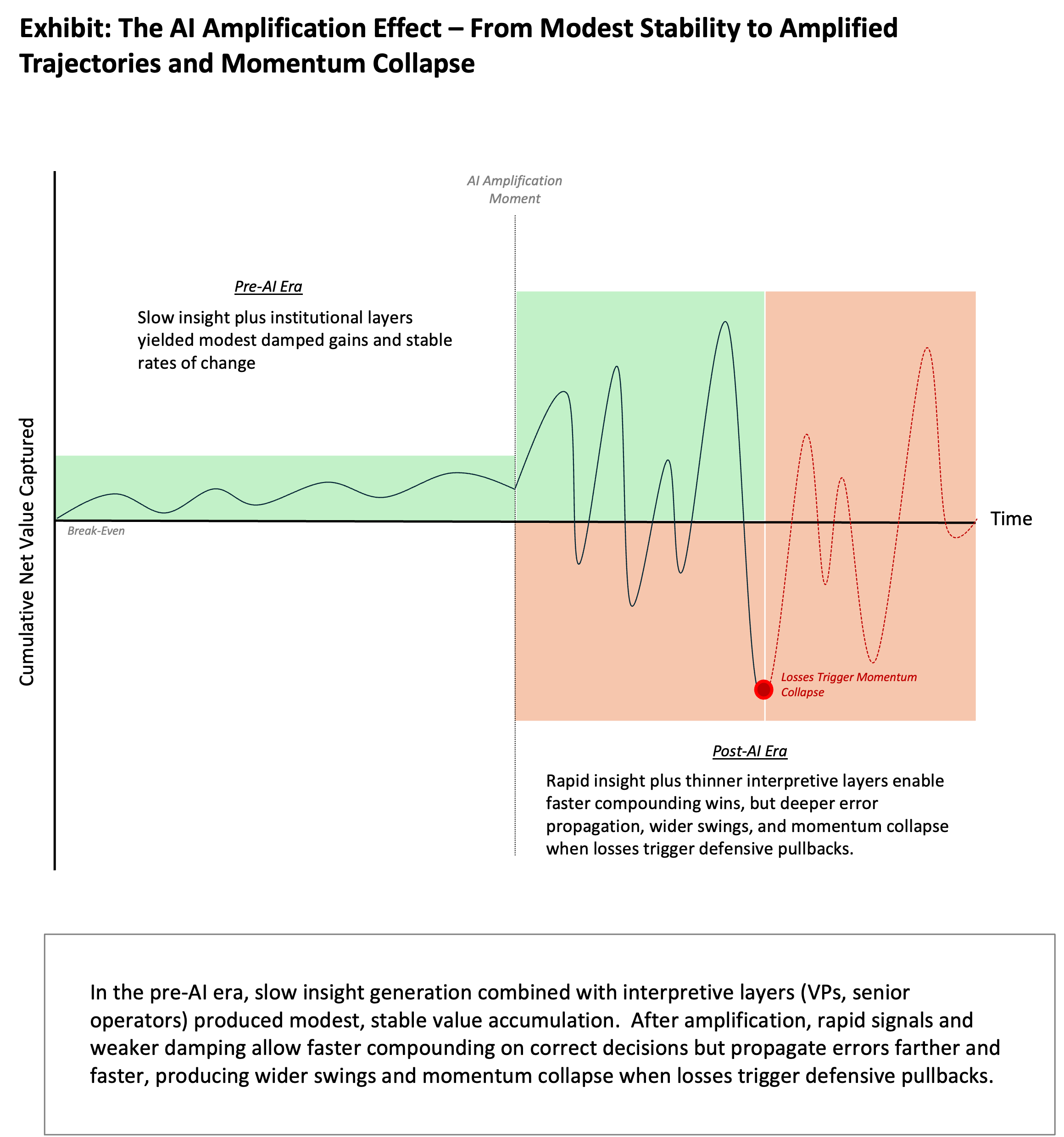
In aviation, fly-by-wire increased responsiveness but risked oscillations without digital damping. Organizations face the parallel: AI increases strategic responsiveness just as interpretive layers that once damped trajectories have disappeared. The required stabilizer is not more technology, it is experienced human judgment delivered in new, lightweight forms.
Real world experience is bearing this out. MIT analyses in 2025, including the GenAI Divide report, indicate that roughly 95% of generative AI pilots yield zero measurable P&L impact or scale, largely because correction arrives too late for learning to compound.
5. Why Mid-Market Organizations Feel It Acutely
Mid-market firms ($100M–$2B revenue) encounter the effect hardest and soonest. They generate abundant AI signals from meaningful complexity but lack enterprise-grade interpretive buffers or formal portfolio processes. Executive teams - often 5–8 members - become the immediate bottleneck.
RSM’s Middle Market AI Survey 2025 captures the squeeze: 91% use generative AI (up from 77% the prior year), yet only 25% report full integration into core operations, with persistent hurdles in data quality, skills, and rollout. Without inherited stabilizers, amplification manifests faster - rapid launches followed by abrupt de-prioritization.
6. Organizational Judgment as the New Scarce Resource
Finite execution capacity now collides with accelerated insight, elevating three irreplaceable human capabilities:
Strategic judgment under uncertainty - the discipline to reject analytically valid but non-core moves, prioritize coherent direction, and preserve narrative focus amid noise.
Clear execution ownership - unambiguous accountability and sequencing authority to enforce “stop” decisions and minimize destructive churn.
Continuity-preserving leadership - intentional pacing to safeguard institutional memory and operational stability through higher-variance cycles.
These were always valuable; the AI Amplification Effect renders them scarce and decisive. Humans may be less needed for coordination or monitoring, but directional judgment under acceleration becomes more - not less essential.
“Speed without navigational control is not advantage – it is instability.”
7. Emerging Ways to Restore Stabilization
As strategic decision velocity accelerates, organizations are rediscovering a capability older corporate structure once provided quietly: judgment-rich stabilization. Historically, managerial layers translated strategic signals into operational reality. They challenged premature commitments, surfaced second-order risks, and slowed escalation until assumptions were tested.
As those layers thin and AI-driven signals arrive faster, organizations must find new ways to restore that stabilizing function without rebuilding the bureaucratic hierarchies of the past.
Several adaptations are beginning to emerge.
Some firms are strengthening portfolio governance, introducing explicit prioritization cadences and kill disciplines to prevent AI-generated initiatives from fragmenting execution. Others are experimenting with lightweight navigation councils, small groups of experienced operators tasked with challenging assumptions and surfacing hidden risks as initiatives begin to scale.
Another approach gaining traction involves seasoned operators in fractional or interim roles, providing pattern recognition, execution realism, and independent challenge without adding permanent hierarchy. Mentions of fractional executive roles have tripled since 2018 according to Revelio Labs, and Gartner projects that more than 30% of midsize firms will have at least one fractional executive on retainer by 2027.
These mechanisms differ structurally, but they perform the same function: they reintroduce interpretation and course correction into increasingly accelerated decision systems. The goal is not to slow organizations down, but to ensure that speed does not come at the expense of direction.
8. The New Leadership Equation
Artificial intelligence is accelerating strategic signal generation at the same moment many corporations have collapsed the managerial layers that historically translated strategy into operational judgment. While flatter organizations and faster analysis promise speed, they also remove the stabilizing mechanisms that historically moderated strategic overreach. The result is amplified strategic trajectories, where correct decisions compound quickly but incorrect ones propagate much further before correction.
Advantage will accrue to organizations that govern this amplification - preserving momentum through judgment-rich friction long enough for learning and value capture to compound.
A New Constraint in the AI Era
For decades, management scholarship has focused on the limits organizations face when making decisions.
Herbert Simon introduced the idea of bounded rationality, showing that managers cannot process all available information and must rely on simplified judgments.
Later work emphasized the role of organizational attention. As information environments expanded, the scarce resource became what leaders could focus on and prioritize.
More recent operating models focused on speed. Digital systems promised faster insight, flatter organizations, and shorter paths from signal to decision.
Artificial intelligence alters this equation.
By dramatically reducing the time required to generate high-confidence analysis, AI removes a constraint that historically slowed strategic commitment. At the same moment, many organizations are continuing to thin the managerial layers that once interpreted and moderated strategic signals.
The result is a new operating challenge.
Earlier generations of operating-model thinking taught us how to move faster under conditions of scarcity. The AI era demands something new: learning how to move with control under conditions of abundance.
In the AI era, navigational control under acceleration is the decisive leadership challenge.
About the Authors
Jon Watts and Dev D’Souza are co-founders of Propel Strategy Group, an operator-led advisory firm focused on large-scale operational and technological transformation for mid-market companies. Their work examines how leadership, operating models, and execution must evolve as artificial intelligence accelerates strategic decision-making.
References
Cyert, Richard M., and James G. March. A Behavioral Theory of the Firm. Englewood Cliffs, NJ: Prentice-Hall, Inc., 1963.
Davenport, Thomas H., and John C. Beck. The Attention Economy: Understanding the New Currency of Business. Boston: Harvard Business School Press, 2001.
Deloitte. State of AI in the Enterprise. Deloitte Insights, 2026.
Gartner. The Future of Fractional Leadership. Gartner Research, 2024.
March, James G., and Herbert A. Simon. Organizations. New York: Wiley, 1958.
McKinsey & Company. The State of AI in 2025: Generative AI’s Breakout Year. McKinsey & Company, 2025.
Simon, Herbert A. Administrative Behavior: A Study of Decision-Making Processes in Administrative Organizations. New York: Macmillan, 1947.
Thompson, James D. Organizations in Action: Social Science Bases of Administrative Theory. New York: McGraw-Hill, 1967.
Revelio Labs. Workforce Intelligence Report on the Rise of Fractional Executives. 2024.